
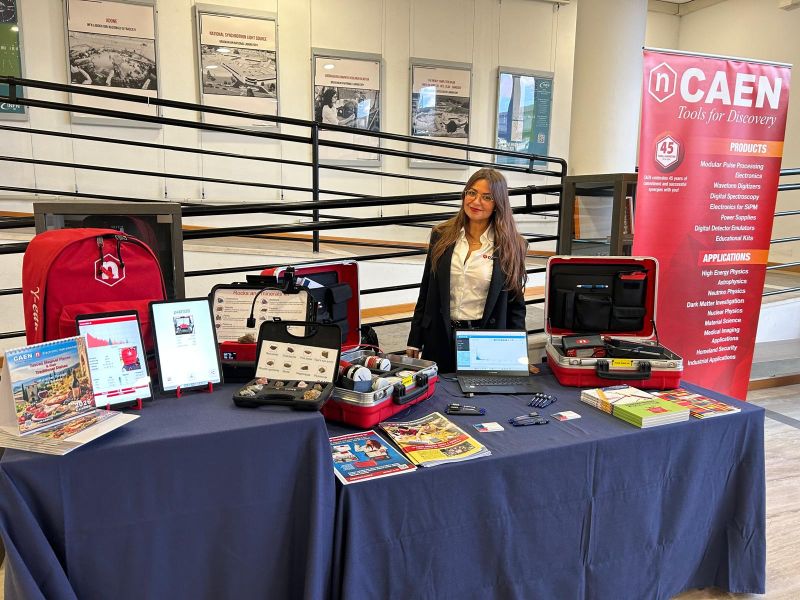
 CAEN participated in the 2026 edition of the INFN Teacher Program (PID), held from 2 to 6 February 2026 at the Frascati National Laboratories (LNF) of the Italian National Institute for Nuclear Physics. The initiative, dedicated to the professional development of secondary school teachers, combined lectures, laboratory activities and moments of direct interaction with researchers and technical experts, offering participants practical tools to bring modern physics and contemporary scientific research methodologies into the classroom.
CAEN’s involvement is part of a broader, long-term strategy to support STEM education through the CAEN Educational project, created to transfer to the educational world the expertise gained over more than forty years of activity in nuclear and high‑energy physics. Today, CAEN acts not only as a provider of advanced instrumentation but also as an active partner in scientific outreach, offering know‑how, experience, and a comprehensive range of educational solutions spanning radioactivity, cosmic rays, nuclear imaging and FPGA programming.
During the 2026 PID, teachers had the opportunity to work directly with CAEN instruments typically used in research laboratories, experimenting with educational kits designed to make complex concepts – such as gamma spectroscopy, particle detection or the statistics of nuclear processes – accessible and engaging. The hands‑on learning approach, a hallmark of CAEN Educational, encourages a deeper understanding of physical phenomena and enables teachers to replicate similar experimental activities in their own schools.
CAEN’s commitment to teacher training is continuous and well‑structured. Over the years, the company has developed an extensive international network involving schools, universities and research centres. Its activities include specialised training courses, masterclasses, thematic schools, seminars for students, company visits, and collaborations with leading academic institutions.
This steady presence and support demonstrate CAEN’s dedication to building a strong bridge between schools and the research community, with the goal of bringing students and teachers closer to STEM disciplines. Participating in programmes such as PID contributes to the growth of an innovative educational ecosystem capable of integrating advanced technology, practical experimentation and modern teaching approaches.