

| Difficult | Execution Time | Data Analysis | Radioactive Sources |
|---|---|---|---|
  |
  |
No | Yes |
Hardware setup
To follow along with this experiment you must have an SP5630EN/ENP educational kit. If you don’t have this kit, choose your own from the following list to visualize the related experiment guides: SG6117A, SG6117B, SG6117E – Educational Kit.
Equipment: SP5630EN/ENP – Environmental Kit
| Model | DT4800 | DT5770 | Additional Tool |
|---|---|---|---|
| Description | Micro Digital Detector Emulator | Portable Digital MCA for Gamma spectroscopy | Gamma Radioactive Source  |
Purpose of the experiment
Determination of the ratio of the effective cross-sections due to Compton and Photoelectric effects as a function of photons energy.
Fundamentals
In the energy range up to 2 MeV, gamma rays interact with matter by two processes:
- Photoelectric Effect, dominant at energy less than 100 KeV. In this process the photon energy is completely transferred to atomic electron bounded: γ + atom Ò ion + e–
- Compton Scattering, linked to the elastic collision between electrons and photons and relevant at 1 MeV energy level: γ + e- -> γ’ + e–‘
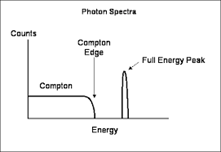
The predominant mode of interaction depends on the energy of the incident photons and the atomic number of the material with which they are interacting. From the acquired γ-spectrum, it is possible to estimate the fraction of events due to Compton scattering and those caused by the photoelectric. The ratio of the event fractions is used to determine the ratio of the two effective cross-sections that depends on the detector size.
Carrying out the experiment
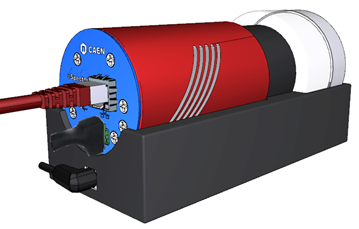
Put the i-Spector digital into the base and place a radioactive source into the empty box (you can use biadesive tape to fix the source into the box). Power on the i-Spector and connect the Ethernet cable. Wait until the temperature is stable from the web interface (it can take half an hour from power on).
Check the waveform, modify the threshold and gate width, if needed, then start the measurement of the energy spectrum.
Take few minutes of acquisition according to the source activity
Results
By using several radioactive sources, the energy dependence of the ratio between the cross-sections of two phenomena can be examined, by verifying that the Photoelectric Effect cross section decreases with increasing energy compared to the Compton Scattering cross section for the used detector size.
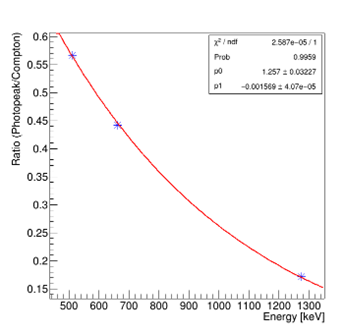
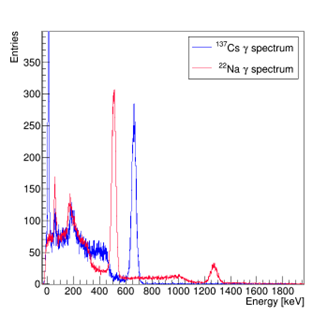
137Cs and 22Na energy spectrum on the left and the ratio between Photopeak and Compton exponential trend.