
| Difficult | Execution Time | Data Analysis | Radioactive Sources |
|---|---|---|---|
  |
  |
Yes | No |
Hardware setup
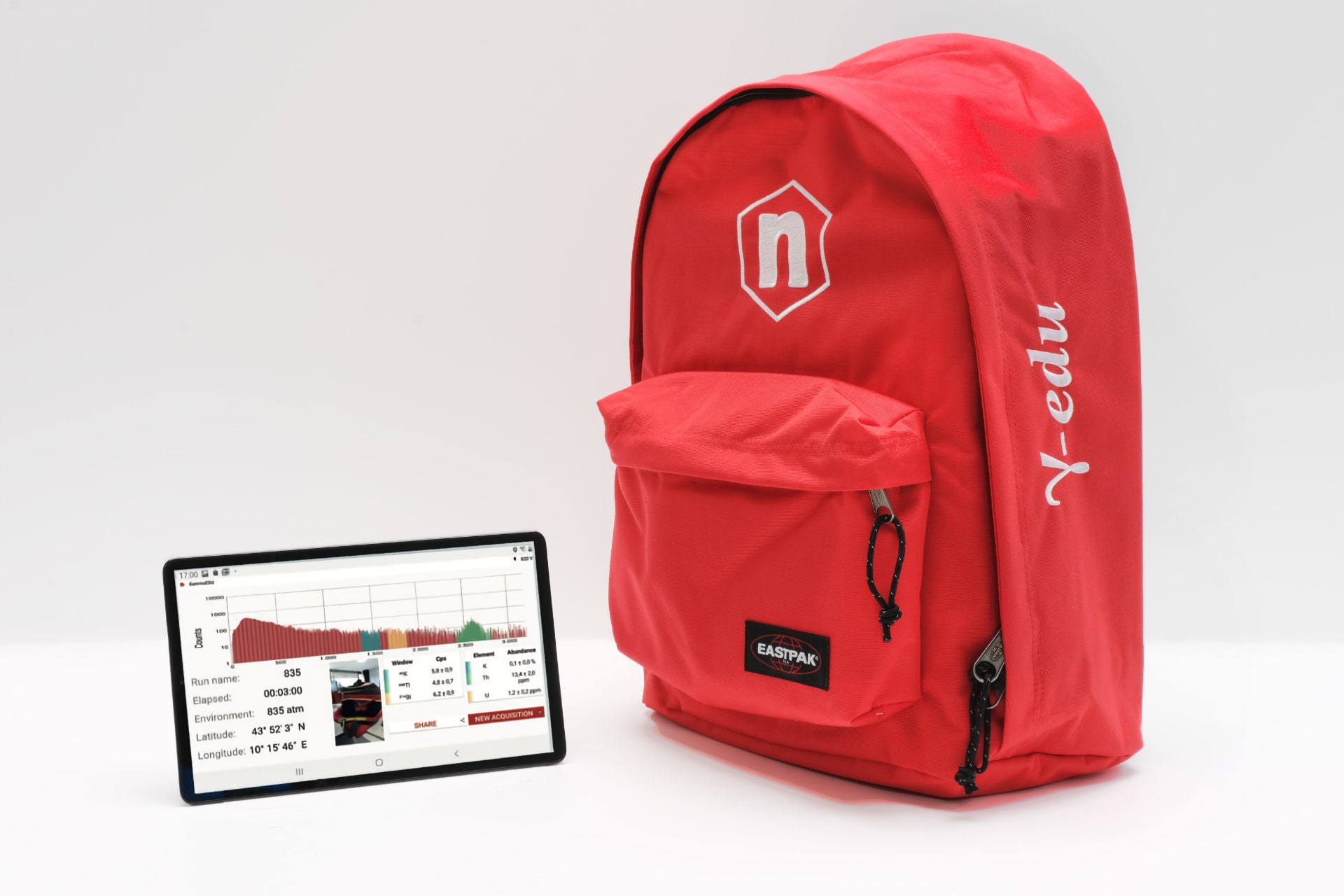
This experiment guide is referred to the SP5640 educational kit.
Equipment: SP5640 – Backpack Detector
| Model | SP5640 |
|---|---|
| Description | Backpack Detector |
Purpose of the experiment
The main goal of the experiment is to understand how the measurement of the γ environmental radiation can be affect by the distance of the point of measurement.
Fundamentals
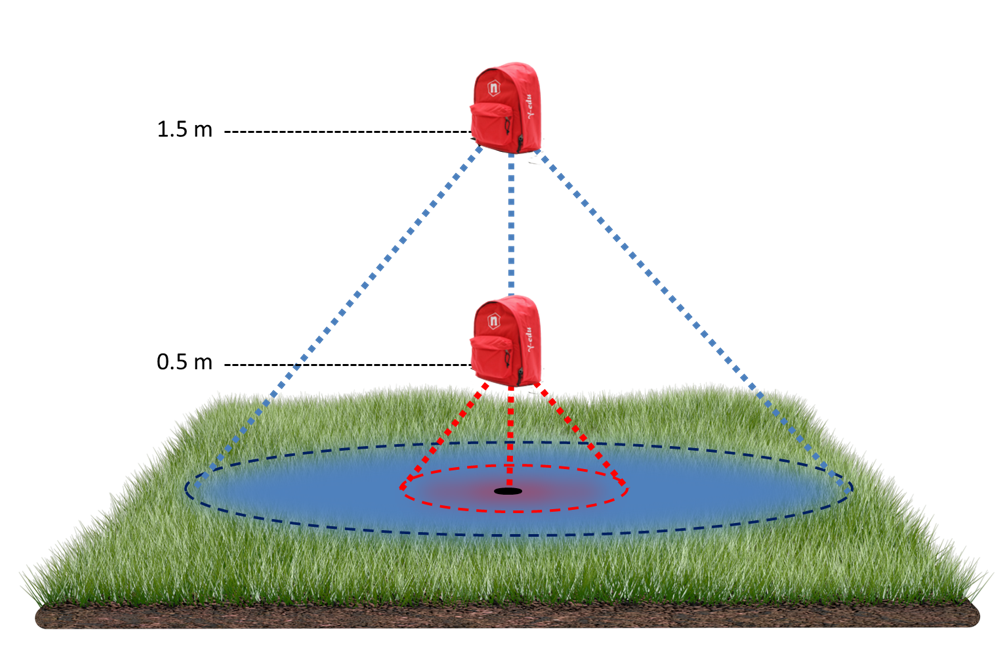
The linear attenuation coefficient of gamma radiation µ represents the inverse of the distance at which the number of photons is reduced by a factor 1/e, as can be inferred by the following equation: N = N0e–µx , where µ in cm–1. This Equation is the key for understanding the lateral horizon of in-situ gamma ray spectroscopy. The horizontal field of view of a gamma-ray detector expresses the relative contribution to the total signal that is produced within a given radial distance from the detector vertical axis. The lateral horizon depends on the height of the detector: for instance, a spectrometer that was placed at ground level detect gammas coming from the first 25 cm of depth and it receives 90% of the signal from a radius of ~0.5 m. At a height of 0.5 m, 95% of the signal come from a radius of ~8 m and the maximum percentage contribution to the flux comes from the concentric hollow cylinder of soil having a ~0.6 m radius centered at the detector vertical axis. When it’s carried on the shoulders of the operator (1.5 m of height) the signal reaches ~95% at ~20 m and the maximum percentage contribution to the flux comes from the concentric hollow cylinder with a radius of ~1.2 m.
Requirements
No other tools or instruments are needed.
Carrying out the experiment
- Power on the γstream inside the red backpack.
- Power on the tablet and associate the two devices via Bluetooth.
- Take care that the γstream internal battery is charged, otherwise use the external power system.
- Start the experiment by placing the backpack on the floor/soil.
- Set the acquisition time to about 5 minutes and see the results. If the statistic is not enough increasing the acquisition time.
- Repeat the measurements at different heights/distances from soil and pay attention to perform the measurements in the same conditions exactly.
Results
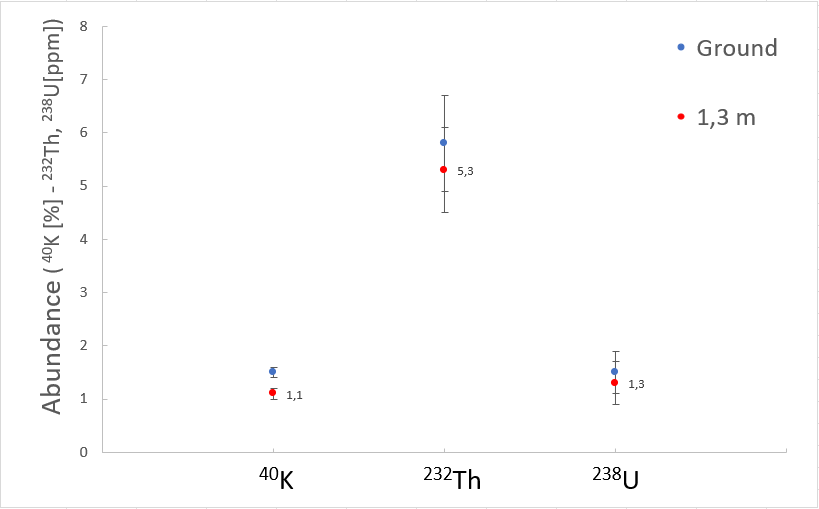
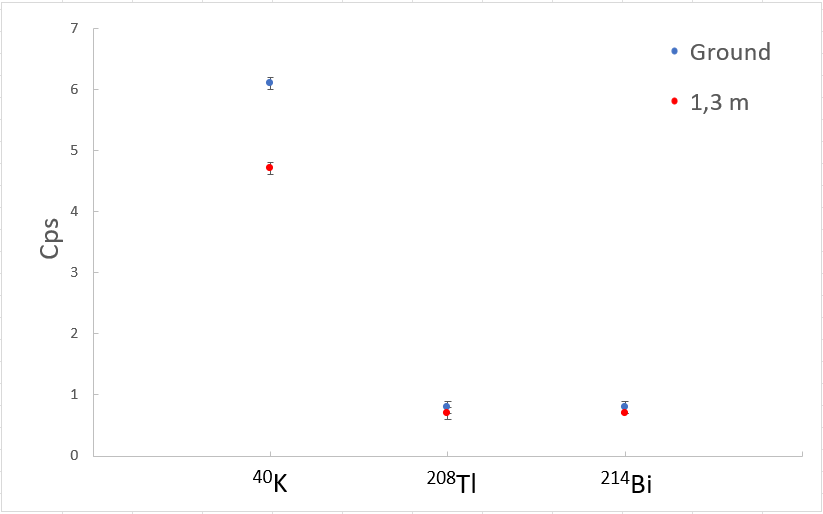
The measurements results show a gamma detection decrease as a function of the soil distance.
a) b)
Result of the in-situ-y-ray measurements that were performed at different heights: the counts per second go three isotopes (plot on the right) and the abundance (plot on the left).