All “Nuclear Physics and Radioactivity” experiments

Caratterizzazione di sensori SiPM per astrofisica e spettrometria gamma

September 24th, 2021| |CAEN Experiments, Gamma Spectroscopy, Nuclear Physics and Radioactivity, Nuclear Physics and Radioactivity, Particle Detector Characterization, Silicon Photomultipliers

Negli ultimi anni si è sviluppata sempre di più la tecnologia per la produzione di un tipo di rivelatore al silicio: il Silicon Photomultiplier (SiPM). Il SiPM è un array di fotodiodi a valanga (APD) posti in parallelo su un comune substrato in silicio. Per le caratteristiche costruttive, i SiPM sono sensibili in un grande intervallo dinamico, dal singolo fotone a 1000 fotoni, nonostante la superficie del dispositivo sia dell’ordine di alcuni mm2, operano ad un basso voltaggio (50V) e sono insensibili ai campi magnetici. Per queste ragioni questi rivelatori sono preferibili ai tradizionali fotomoltiplicatori indiverse applicazioni. Le tecniche basate sul conteggio dei fotoni e sul loro tempo di arrivo, sono utilizzate in molti ambiti di ricerca: nella caratterizzazione di diodi laser e fibre ottiche, in astronomia, in fisica nucleare e nelle misure di emissione di decadimenti fluorescenti in medicina, chimica, scienza dei materiali e biologia. Lo scopo di questa tesi è quello di caratterizzare ed effettuare delle misure di rumore ed efficienza su due tipi diversi di SiPM prodotti dalla Hamamatsu Photonics: • Il modello S12571-100C (2013) • Il modello S13360-1350CS (2016)

An Educational Experience with Linear Absorption Coefficient

September 24th, 2021| |CAEN Experiments, Gamma Spectroscopy, Nuclear Physics and Radioactivity, Nuclear Physics and Radioactivity

In this paper is presented a simple procedure for evaluating the absorption coefficient of aluminum (Z = 13) using a gamma-emitting nuclide, highlighting the characteristics and limits that characterize the measurement. Using the educational kit caen, is possible to investigate the full potential of the adopted method. The results obtained give great confidence in the instruments and the aim of this work is to provide the first tools for conducting a good spectroscopic analysis.

Report on A.1.1 and B.1.5 experiments: a combined analysis

September 24th, 2021| |CAEN Experiments, Gamma Spectroscopy, Nuclear Physics and Radioactivity, Nuclear Physics and Radioactivity, Particle Physics, Silicon Photomultipliers

We report on a common analysis for the experiments of SiPM characterization (A.1.1) and comparison of dierent scintillating crystals: light yield, decay time and resolution (B.1.5). With this proposal, we use CAEN educational kit premium, based on SP5600 power supply and amplication unit connected to the SP5650C SiPM and the DT5720A digitizer. On one hand, we use the SP5601 LED driver. On another hand we use a 137Cs gamma source coupled individually to BGO, LYSO(Ce) and CsI(Tl) crystals with a constant volume (6x6x15 mm3). In the former case, we vary the amplitude (intensity) of the LED driver and verify the spectroscopic response. In the latter case, the light yield is due to a 137Cs gamma source interaction with the respective crystal, and again a spectroscopic response is analyzed. As a proof of concept, pulse high and pulse shape analyses are also proposed. Schematic comparisons of the results obtained with the three crystals are presented.

SiPM Spectrometer: detection of γ‐ray

September 24th, 2021| |CAEN Experiments, Gamma Spectroscopy, Nuclear Physics and Radioactivity, Nuclear Physics and Radioactivity

Even if a SiPM is able to detect very low light intensity, it can be used for detecting a large amount of light in radiation detection with scintillators. The CAEN Mini Spectrometer is based on a Hamamatsu 3×3 mm2 SiPM, model MPPC S10362‐33‐050C, coupled to a scintillating crystal. This sensor, with its 3600 cells, provides a wide dynamic range, allowing the building of a mini spectrometer. Its Dark Count Rate (DCR), due to the large amount of pixels, is one order of magnitude higher than that of the 1×1 mm2; its Dark Count Rate at 0.5 ph. is 3÷4 MHz: this is not a problem for the spectrometer application because we are not interested in counting photons, but in measuring the electrical charge of the large pulse obtained by the pixels signal overlap. A right threshold will remove all the spurious hits.

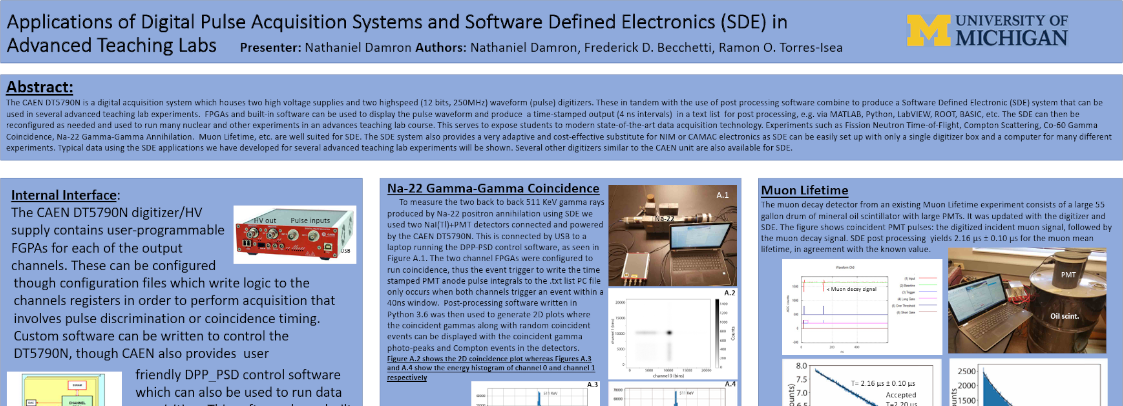
Applications of Digital Pulse Acquisition Systems and Software Defined Electronics (SDE) in Advanced Teaching Labs

September 24th, 2021| |CAEN Experiments, Cosmic Rays, Gamma Spectroscopy, Nuclear Physics and Radioactivity, Particle Physics, Particle Physics

The CAEN DT5790N is a digital acquisition system which houses two high voltage supplies and two highspeed (12bits, 250MHz) waveform (pulse digitizers. These in tandem with the use of post processing software combine to produce a Software Defined Electronics (SDE) system that can be used in several advanced teaching experiments. FPGAs and built-in software can be used to display the pulse waveform and produce a time-stamped output (4 ns intervals) in a text list for post processing, e.g via MATLAB, Python, LabView, ROOT, BASIC, etc. The SDE can than be reconfigured as neeeded and used to run many nuclear and other expermiments in an advances teaching lab course. This serves to expose students to modern state-of-the-art data acquisition technology. Experiments such as Fission Neutron, Time-of-Flight, Comptron Scattering, Co-60 Gamma Coincidence, Na-22 Gamma-Gamma Annighilation. Muon Lifetime, etc. are well suited for SDE. The SDE system also provides a very adaptive and cost-effective substitute for NIM or CAMAC electronics as SDE can be easily set up with only a single digitizer box and a computer for many different experiments. Typical data using the SDE application we have developed for several advanced teaching lab experiments will be shown. Several other digitizers similar to the CAEN unit are also available for SDE.

Hands-on Photon Counting Statistics

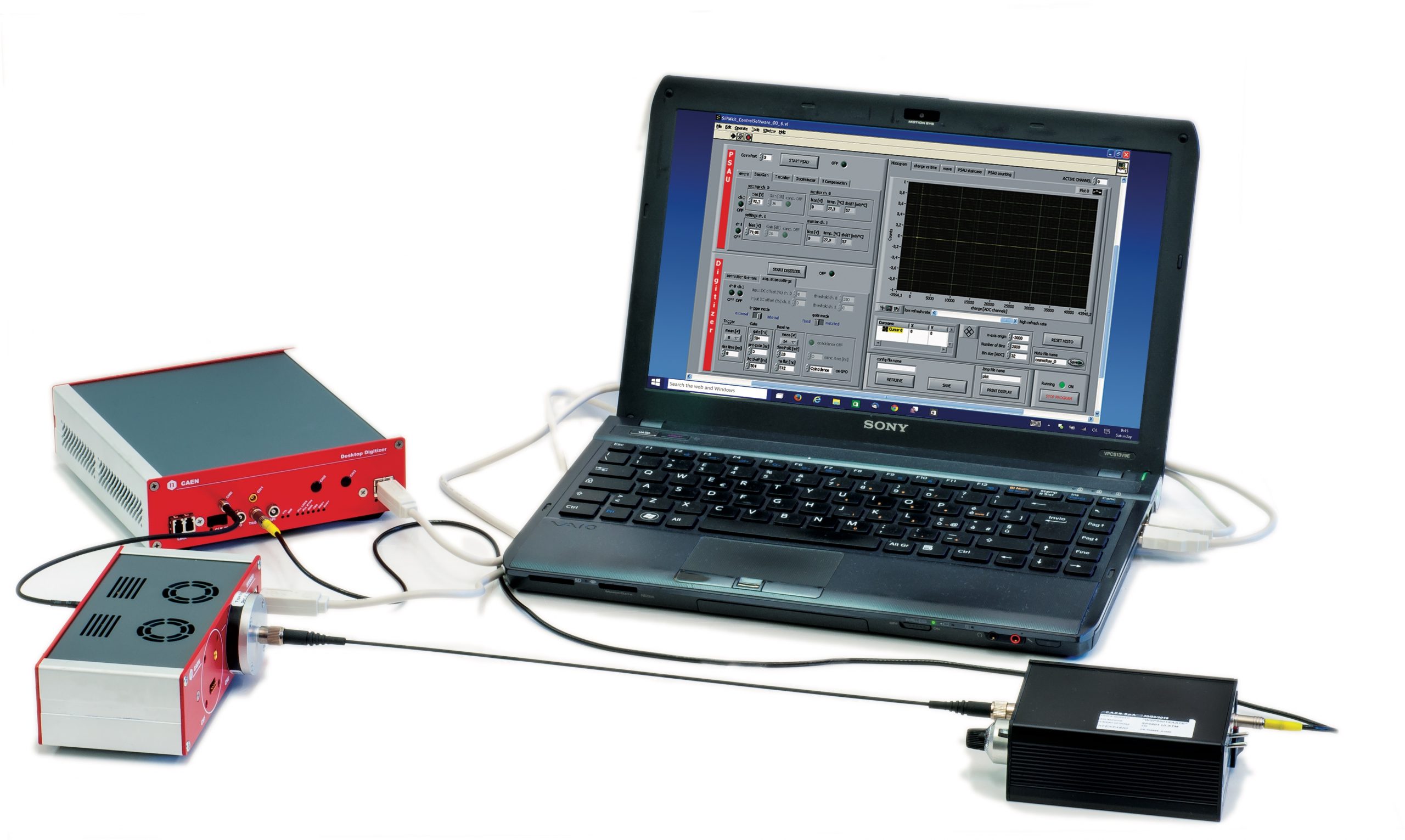
Download printable version Difficult Execution Time Data Analysis Radioactive Sources Yes No Hardware setup This experiment guide is referred to the SP5600E/AN Educational Kit. Equipment: SP5600E - Educational Photon Kit Model SP5600 DT5720A SP5601 SP5650C Description Power Supply and Amplification Unit Desktop Digitizer 250 MS/s LED Driver Sensor Holder for SP5600 with SiPM

Spatial Resolution

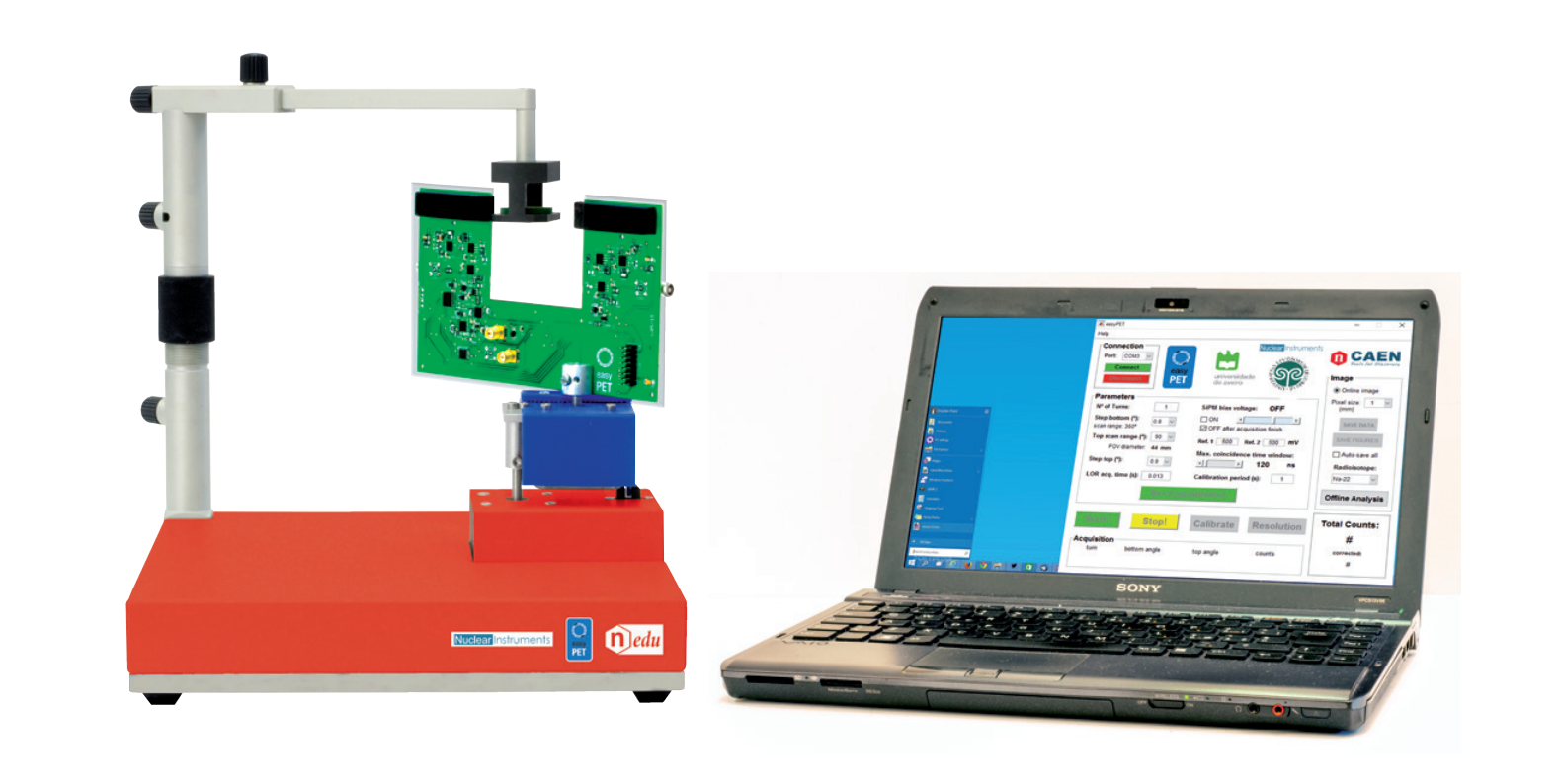
Download printable version Difficult Execution Time Data Analysis Radioactive Sources Yes Yes Hardware setup This experiment guide is referred to the SP5700 educational kit. Equipment: SP5700 - EasyPET Model SP5700 Additional Tool Description EasyPET 22Na Radioactive source (recommended: 1/2 inch disc, 10 μCi) Purpose of the experiment Evaluation of the spatial resolution of

Two-dimensional Reconstruction of a Radioactive Source

Download printable version Difficult Execution Time Data Analysis Radioactive Sources No Yes Hardware setup This experiment guide is referred to the SP5700 educational kit. Equipment: SP5700 - EasyPET Model SP5700 Additional Tool Description EasyPET 22Na Radioactive source (recommended: 1/2 inch disc, 10 μCi) Purpose of the experiment Understanding the technique of the nuclear