
| Difficult | Execution Time | Data Analysis | Radioactive Sources |
|---|---|---|---|
  |
  |
Yes | No |
Hardware setup
This experiment guide is referred to the SP5660 Educational Kit.
Equipment: SP5660 – RockyRAD
| Model | SP5660 |
|---|---|
| Description | RockyRAD |
Purpose of the experiment
The fundamental objective of this nuclear physics educational experiment is to provide students with a practical understanding of how the intensity of gamma radiation changes proportionally to the square of the distance from a rock sample.
Fundamentals
The Inverse Square Law, governing the behaviour of gamma radiation, asserts that the intensity of gamma rays is inversely proportional to the square of the distance from the radiation source.
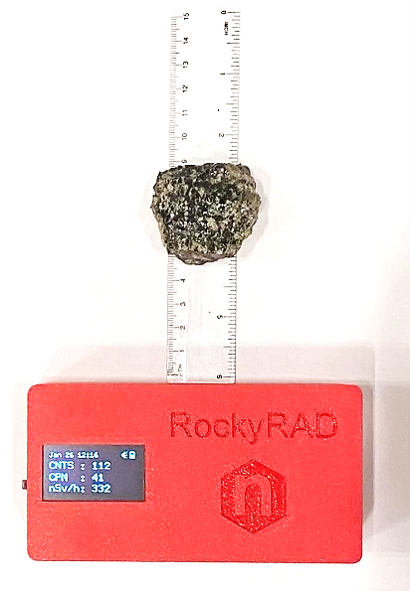
Experimental setup.
In the context of gamma rays, which arise from nuclear transitions, their electromagnetic nature becomes paramount. These high-energy photons exhibit a unique ability to penetrate matter, making them invaluable in various applications from medical imaging to industrial processes. The Inverse Square Law articulates how the intensity diminishes rapidly as one moves away from the source, emphasizing the significance of distance in influencing the impact of gamma radiation. Mathematically, this can be expressed as: I = I0/r2, where I is the intensity of radiation at a distance r from the source and I0 is the initial intensity of radiation at the source.
In the context of this experiment, a GM (Geiger-Muller) counter is utilized to measure the intensity of gamma radiation at varying distances from the gamma ray source. The GM counter is a radiation detector that produces an electrical pulse when ionizing radiation interacts with its gas-filled chamber. By measuring the number of pulses, we can infer the intensity of the gamma radiation.
Carrying out the experiment
Begin by placing the GM detector on the desk and powering on the system. The GM detector will immediately initiate measurements and record data every minute during acquisition. Background counts, essential for calibration, should be obtained in the absence of samples, specifically with the GM tube window uncovered.
Upon completing the background measurement, place a rock sample at the first know distance from the middle of the open window of the GM detector, and start the acquisition.
Systematically increase the sample distance from the GM detector and record the corresponding CPM values.
Repeat the measurements for multiple distances.
Results
Analyzing the collected data allows the students to determine whether the intensity of gamma radiation follows the expected Inverse Square Law relationship. This experiment provides valuable hands-on experience in nuclear physics and reinforces fundamental concepts related to the behaviour of gamma radiation.
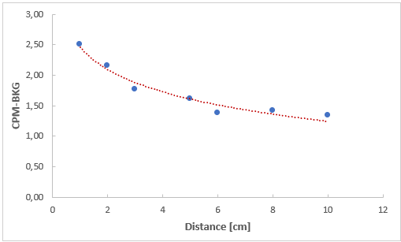
Graph of the net CPM as a function of the distance.