
| Difficult | Execution Time | Data Analysis | Radioactive Sources |
|---|---|---|---|
  |
  |
Yes | No |
Hardware setup
This experiment guide is referred to the SP5660 Educational Kit.
Equipment: SP5660 – RockyRAD
| Model | SP5660 |
|---|---|
| Description | RockyRAD |
Purpose of the experiment
The experiment aims to investigate the variation of dose equivalent rate with altitude during an aircraft flight. The measurements allow the user to observe the increase in cosmic radiation exposure as the atmospheric shielding decreases.
Fundamentals
Cosmic radiation originates from high-energy particles arriving from outer space and from the Sun. When these primary particles interact with the Earth’s atmosphere, they generate secondary radiation fields composed of neutrons, photons, electrons, muons, and other particles. The atmosphere acts as a natural shield, reducing radiation levels at ground level. As altitude increases, the thickness of the protective atmospheric layer decreases, leading to higher dose equivalent rates.
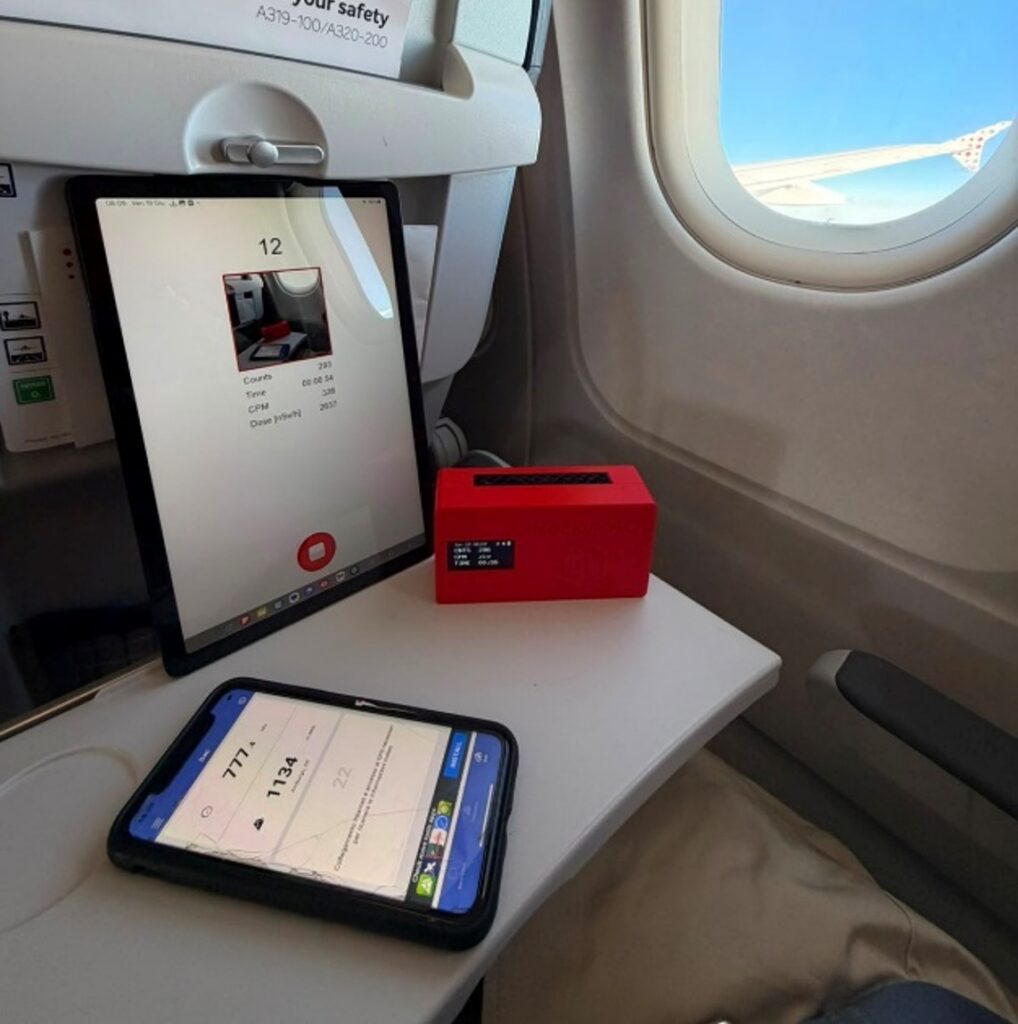
Experimental setup
Commercial aircraft typically cruise at altitudes between 9 and 12 km, where radiation levels can be several times higher than those measured at sea level. For this reason, flight crews are considered occupationally exposed workers in many radiological protection regulations.
Carrying out the experiment
Before boarding, start the detector and record the ambient dose equivalent rate at ground level. Continue the acquisition throughout the flight, ensuring that both radiation measurements and altitude data are recorded at regular intervals. Measurements should cover the main flight phases: takeoff, climb, cruise, descent, and landing. To improve statistical significance, data averaging over several minutes may be applied. After the flight, correlate the measured dose equivalent rate with the corresponding altitude values.
Results
The user can easily observe the dependence of ambient dose equivalent rate on altitude by comparing measurements collected during the various flight phases. The results typically show a gradual increase during ascent, reaching maximum values at cruising altitude, followed by a decrease during descent.
Depending on flight altitude and geomagnetic latitude, dose equivalent rates at cruise altitude may be several times higher than those measured at ground level.
The data clearly confirm the strong dependence of cosmic radiation exposure on altitude, even during a short commercial flight such as Hamburg–Brussels.
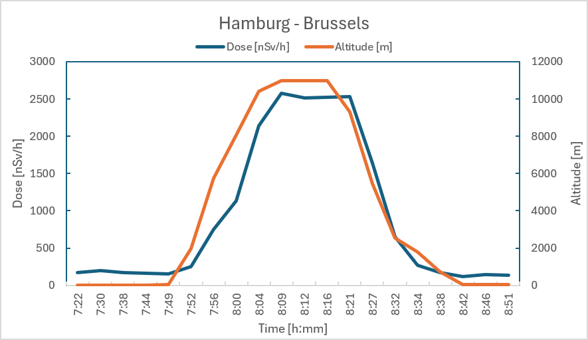
Equivalent rate (blue, nSv/h) and aircraft altitude (orange, m) as a function of time during a short commercial flight (Hamburg–Brussels).