| Difficult | Execution Time | Data Analysis | Radioactive Sources |
|---|---|---|---|
  |
  |
Yes | No |
Purpose of the experiment
Demonstrate how to implement a threshold discriminator and count events exceeding that threshold using logic blocks on the DT1260 with Sci-Compiler. The goal is to convert an analog or digital input into a binary “event” signal and record how many such events occur over time.
Fundamentals
A threshold discriminator outputs a logic high when its input signal crosses a predetermined level. This mechanism enables digital detection of analog signal excursions. An event counter then increments each time a discriminator output transitions (i.e., detects a “hit”). These functions are fundamental in instrumentation and particle detection systems, where counting the number of threshold crossings (or pulses) is essential. Synchronization with FPGA clocking ensures reliable digital sampling and avoids metastability.
Carrying out the experiment
- Activate your Sci-Compiler license and set up the software installation.
- Plug the USB Dongle in your PC and launch Sci-Compiler.
- Create a project for your DT1260 unit: press New Project.
- First, the FPGA firmware is created with the following functional blocks: an analog comparator that compares the input signal with the programmable threshold, a register to control the threshold value, a counter that increments when the signal crosses the threshold, a reset register to clear the counter when needed.
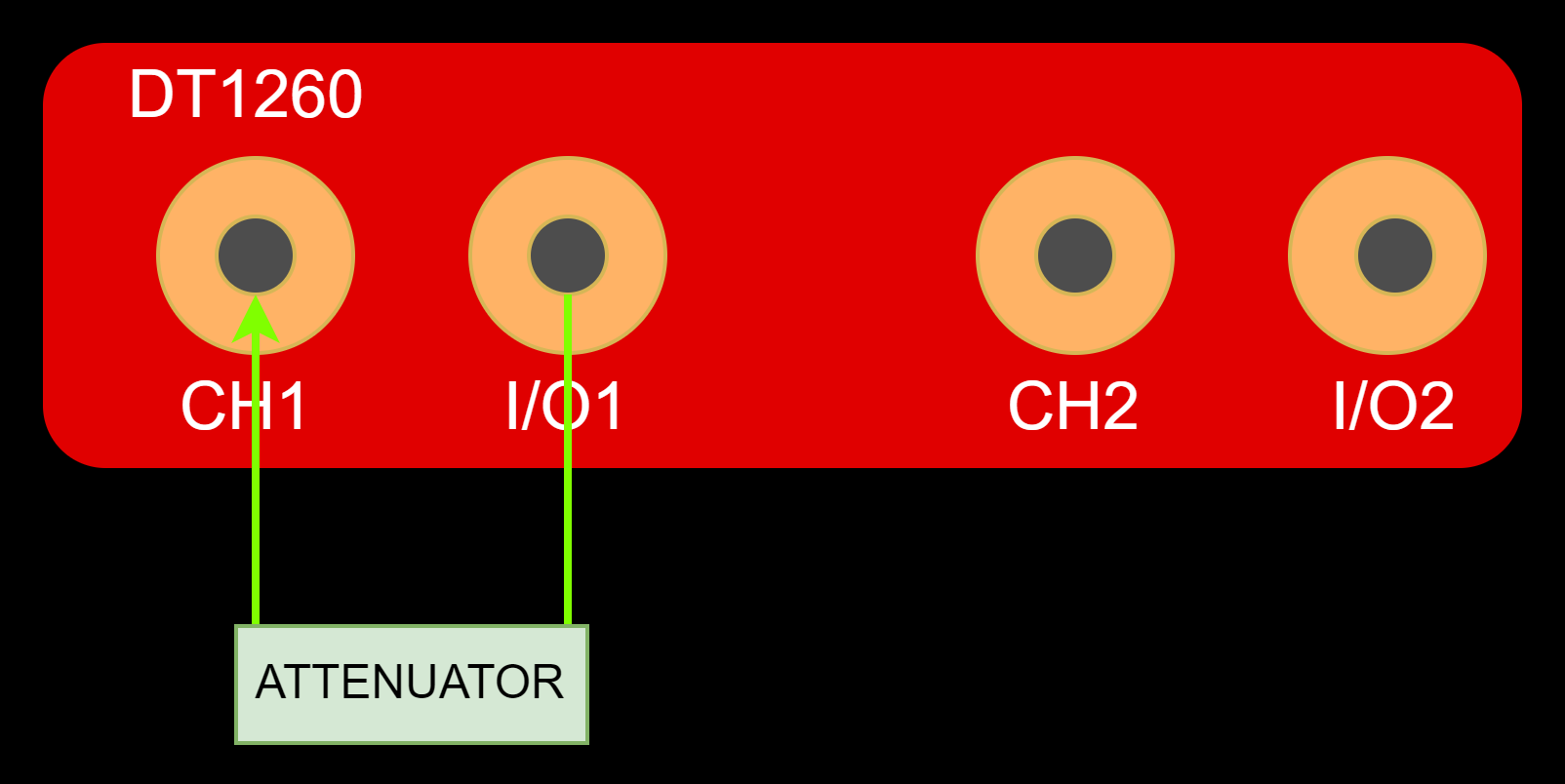
- After compiling the design and programming the DT1260 board, the system can be tested using the DT4800 connected to the DT1260 analog input. The integrated oscilloscope tool in Sci-Compiler can be used to observe both the analog waveform and the digital discriminator output.
Results
The implemented system generates a digital pulse each time the input signal crosses the programmed threshold and increments the event counter accordingly. By combining the Comparator, Edge Detector, Counter, and memory-mapped registers, the firmware implements a configurable threshold discriminator capable of counting how many times the incoming analog signal exceeds the selected level. By adjusting the threshold value, students can observe how the number of detected events changes. This illustrates the fundamental principle of signal discrimination and event counting, which is widely used in detector readout systems for radiation and particle physics experiments.
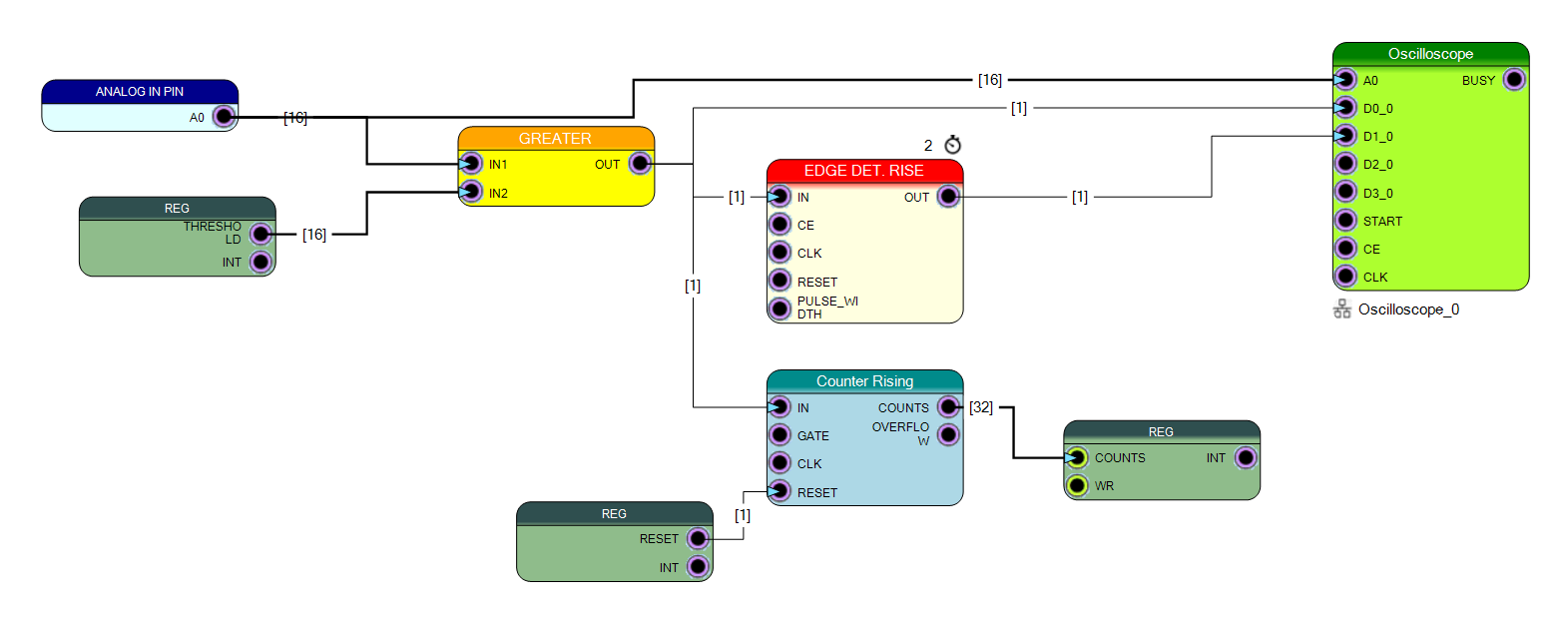
Counter with register schematic.