| Difficult | Execution Time | Data Analysis | Radioactive Sources |
|---|---|---|---|
  |
  |
Yes | No |
Purpose of the experiment
The aim of this experiment is to compare different trigger algorithms used to detect signal events in digital readout systems.
Fundamentals
In detector readout electronics, a trigger is used to determine when a valid signal event occurs. Different trigger algorithms can be implemented depending on the signal characteristics and noise conditions.
The Leading Edge trigger generates an event when the signal crosses a fixed threshold. Adding hysteresis introduces a second threshold for returning below the trigger level, helping to avoid false triggers caused by noise fluctuations. A Derivative trigger operates on the derivative of the signal, detecting rapid changes in amplitude. This approach is useful for identifying the rising edge of pulses and improving timing precision.
A Trapezoidal trigger is based on digital filtering of the signal using a trapezoidal shaping algorithm. This method enhances the signal-to-noise ratio and can provide more stable triggering for signals with varying amplitude. By implementing and comparing these methods in FPGA firmware, students can study how different trigger strategies influence signal detection.
Requirements
Python environment.
Carrying out the experiment
- Activate your Sci-Compiler license and set up the software installation.
- Plug the USB Dongle in your PC and launch Sci-Compiler.
- Create a project for your DT1260 unit: press New Project.
- A firmware design is implemented including three parallel trigger paths: Leading Edge discriminator with hysteresis, Derivative based trigger, Trapezoidal filter trigger.
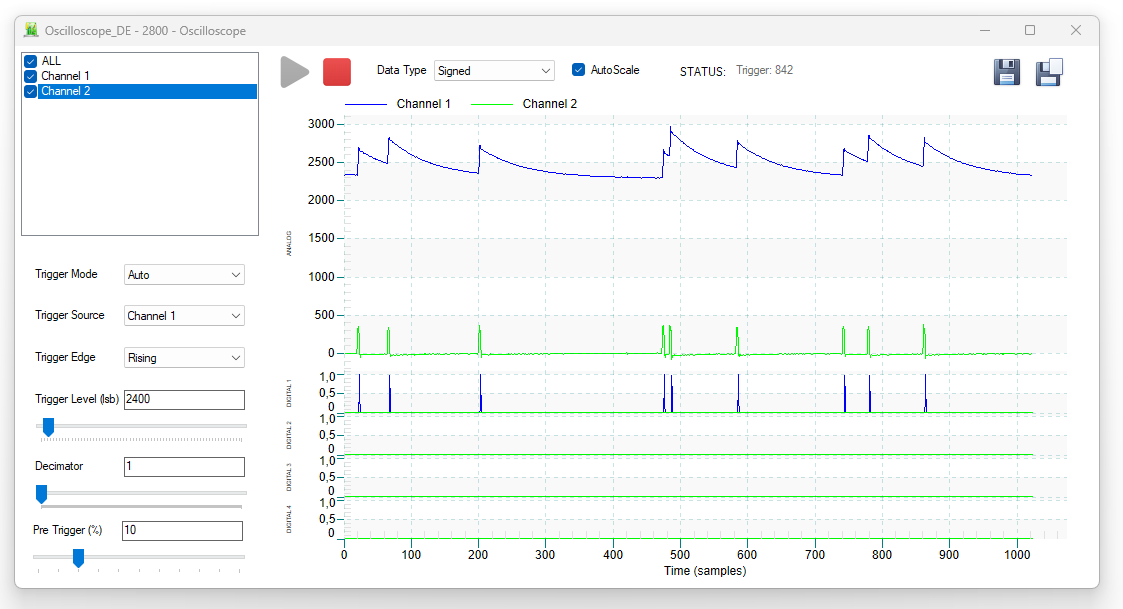
- The input signal is applied to the board and processed simultaneously by the three trigger algorithms. The resulting trigger signals can be monitored and compared using the acquisition software.
- By adjusting parameters such as threshold values and filter settings, students can observe how each trigger method responds to the same input signal.
Results
The experiment allows students to compare the behaviour of the three trigger techniques when processing identical input pulses. Differences can be observed in trigger timing, noise sensitivity, and stability. The Leading Edge trigger provides a simple and fast detection method, while the derivative trigger improves sensitivity to rapid signal changes. The trapezoidal trigger, thanks to digital filtering, offers more robust performance in the presence of noise. This comparison highlights how different trigger algorithms affect signal detection and timing accuracy in digital detector readout systems.