| Difficult | Execution Time | Data Analysis | Radioactive Sources |
|---|---|---|---|
  |
  |
Yes | No |
Purpose of the experiment
This experiment introduces the concept of pulse shaping in detector readout electronics. Students explore how a CR–RC² shaping filter can be implemented in FPGA firmware to process detector signals and improve their suitability for amplitude measurements.
Fundamentals
In radiation and particle detection systems, the signals produced by detectors often contain noise and long decay tails that can complicate amplitude measurements. To improve signal quality, the waveform is typically processed by a shaping amplifier.
A common shaping method is the CR–RC² filter, which combines a high-pass stage (CR) with two low-pass stages (RC²). This configuration differentiates the signal and then integrates it, producing a semi-Gaussian shaped pulse with improved signal-to-noise ratio and reduced baseline fluctuations.
Pulse shaping helps to stabilize the signal amplitude and makes it easier to perform accurate measurements in subsequent processing stages such as peak detection or spectroscopy.
Requirements
Python environment.
Carrying out the experiment
Activate your Sci-Compiler license and set up the software installation. Plug the USB Dongle in your PC and launch Sci-Compiler. Create a project for your DT1260 unit: press New Project. firmware design is implemented including a CR–RC² digital shaping filter that processes the incoming waveform samples.
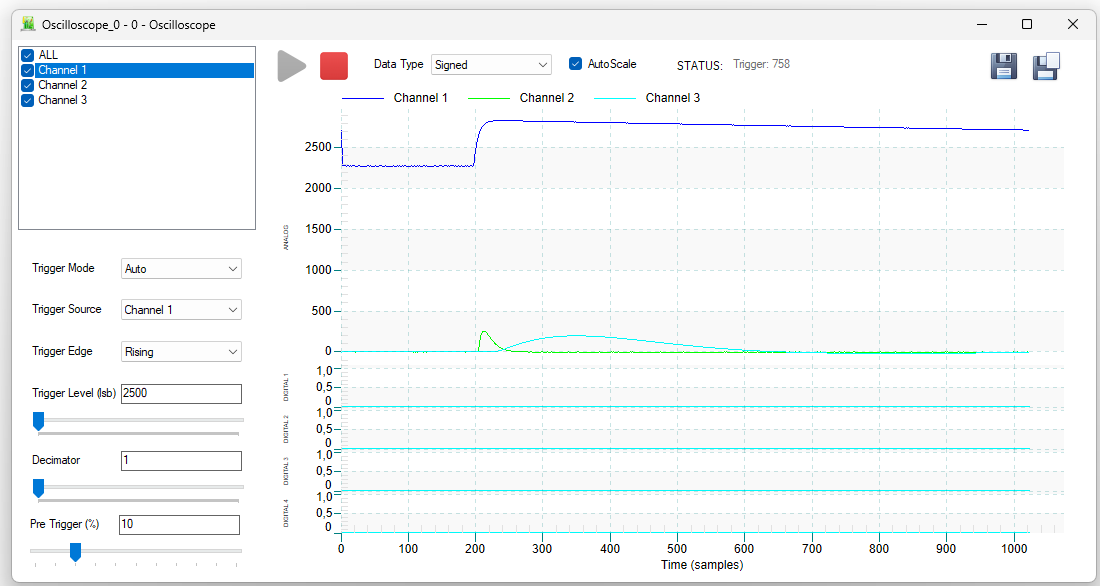
The input signal generated by the pulse source is fed into the shaping module. The filter transforms the original waveform into a shaped pulse with smoother characteristics and reduced noise influence. Students can observe and analyze the shaped waveform through the acquisition software.
Results
The CR–RC² filter produces a semi-Gaussian shaped pulse from the original detector signal. Students can observe how the shaping process smooths the waveform and reduces noise effects. This experiment demonstrates how digital pulse shaping techniques are used to improve signal quality and prepare detector signals for accurate amplitude and energy measurements.