
| Difficult | Execution Time | Data Analysis | Radioactive Sources |
|---|---|---|---|
  |
  |
Yes | Gamma |
Hardware setup
This experiment guide is referred to the SP5630ENP educational kit.
Equipment: SP5630ENP
| Model | SP5630ENP | Additional Tool |
|---|---|---|
| Description | Gamma Radiation and Shielding Laboratory | Additional Gamma Radioactive Source  |
Purpose of the experiment
Comparison of the shielding capability of Aluminium and Lead, and study of the dependence of the attenuation on the atomic number of the material.
Fundamentals
The probability of photoelectric absorption increases strongly with the atomic number Z of the material (approximately as Z4-5), while the Compton scattering probability per unit mass is almost independent of Z. For this reason, high-Z materials such as Lead (Z = 82) are much more effective than light materials such as Aluminium (Z = 13) in shielding gamma rays, especially at low energies. Comparing the attenuation as a function of the mass thickness (ρ·x, in g/cm²) highlights the role of the atomic number, independently of the different densities of the two materials (Al: 2.70 g/cm3, Pb: 11.35 g/cm3). One Lead absorber (≈ 1.8 g/cm²) is comparable to all eight Aluminium absorbers (≈ 1.4 g/cm²).
Carrying out the experiment
Place the i-Spector Digital in the mechanical support and the radioactive source in the source holder, at a fixed distance from the detector. Keep this geometry unchanged for the whole experiment.
Connect the i-Spector Digital to the PC with the Ethernet cable, power it on and wait until the detector temperature is stable.
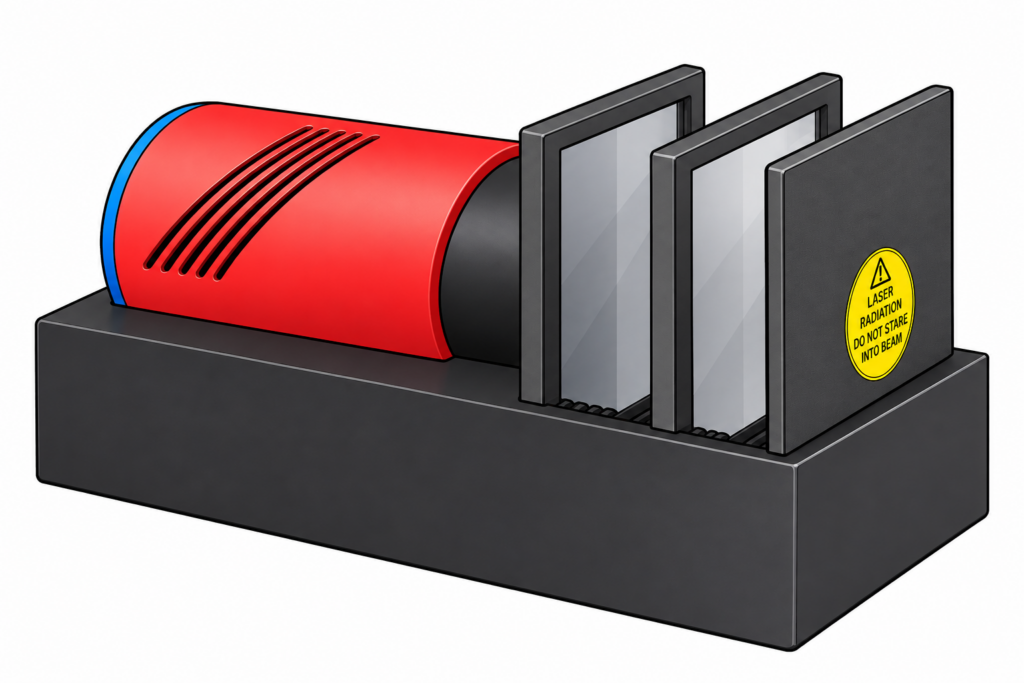
Experimental setup
Reference spectrum: Acquire a spectrum without absorbers for a fixed time (e.g. 10 minutes). Define a ROI around the photopeak and record the net counts.
Aluminium: Place the Aluminium absorbers between the source and the detector one at a time, up to 8. After each addition, acquire a spectrum with the same time and settings and record the net counts in the same ROI. Lead: Remove the Aluminium absorbers and repeat step 2 with the Lead absorbers.
Results
Plot ln(I/I0) as a function of the thickness and of the mass thickness for both materials. The slopes give the linear and mass attenuation coefficients. Compare the thickness of Aluminium and Lead needed to obtain the same attenuation. Plot ln(I/I₀) of the 662 keV photopeak as a function of the thickness and of the mass thickness for both materials: the difference between the two materials is large per unit thickness and small per unit mass. Comparing the spectra with one Lead and eight Aluminium absorbers, the 32 keV peak is almost completely removed by Lead and only partially by Aluminium.
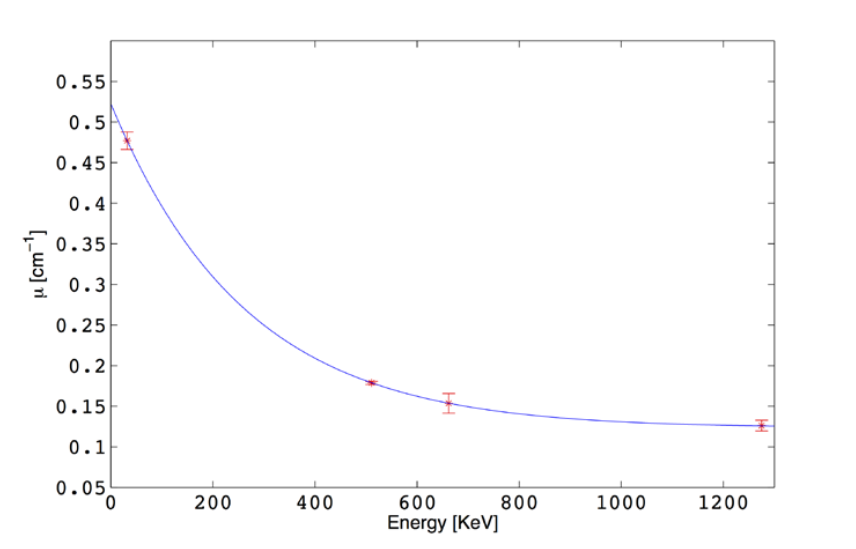
Gamma attenuation coefficient of Aluminium as a function of energy.