
| Difficult | Execution Time | Data Analysis | Radioactive Sources |
|---|---|---|---|
  |
  |
No | Yes |
Hardware setup
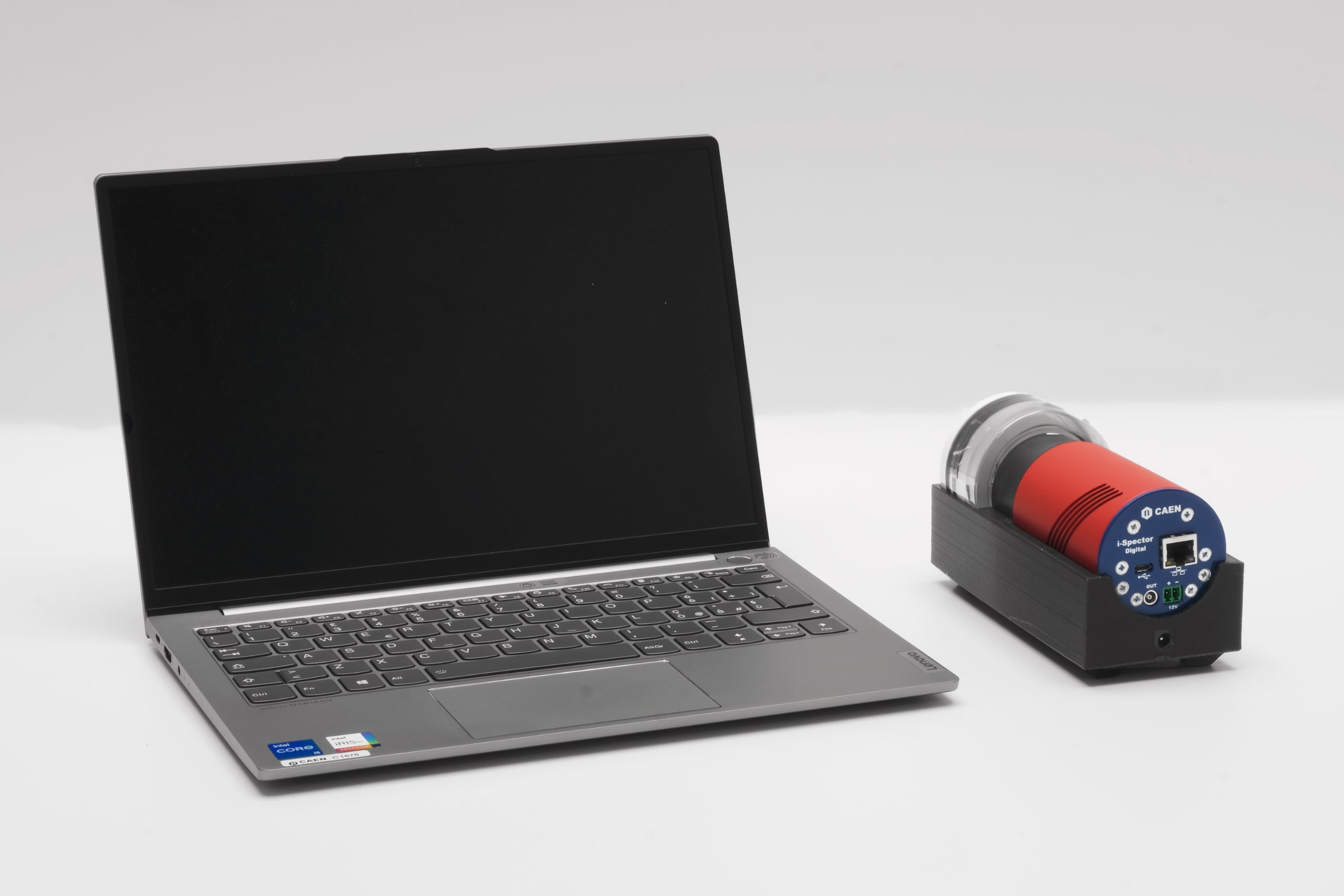
This experiment guide is referred to the SP5640 educational kit. If you don’t have this kit, choose your own from the following list to visualize the related experiment guide: SG6111A, SG6111C – Educational Kit.
Equipment: SP5640 – Backpack Radiation Detector
| Model | γ-Stream | Additional Tool |
|---|---|---|
| Description | Portable System for γ-ray Spectroscopy | Gamma Radioactive Source  |
Purpose of the experiment
γ-radioactivity detection by using a system composed of a scintillating crystal coupled to a photon detector.
Fundamentals
γ-rays interact with matter by three processes: Compton Scattering, Photoelectric Effect and Pair Production (whenever the energy exceeds the 1.022 MeV threshold corresponding to the e+e– rest mass). The cross section of each process depends on the energy of the γ-ray.
The Compton Effect is the inelastic scattering between the incoming photon and an atomic electron. In the Photoelectric Effect, the incident γ-ray transfers all its energy to a bound electron which acquires a kinetic energy equal to the incoming γ-energy decreased by the binding energy.
These processes convert, totally or partially, the γ-ray energy into kinetic energy of electrons (or positrons, in case of pair production). The interaction of the charged particles with the atomic and molecular systems of the medium results in excited states whose decay, possibly mediated, leads to light in the visible or UV region, eventually detected by the light sensor. A wide range of scintillator products is available today, differing for the light yield, the material properties, the time characteristics of the scintillation light and, last but not least, cost. The choice of the scintillator is essentially dependent on the specific targeted application.
Carrying out the experiment
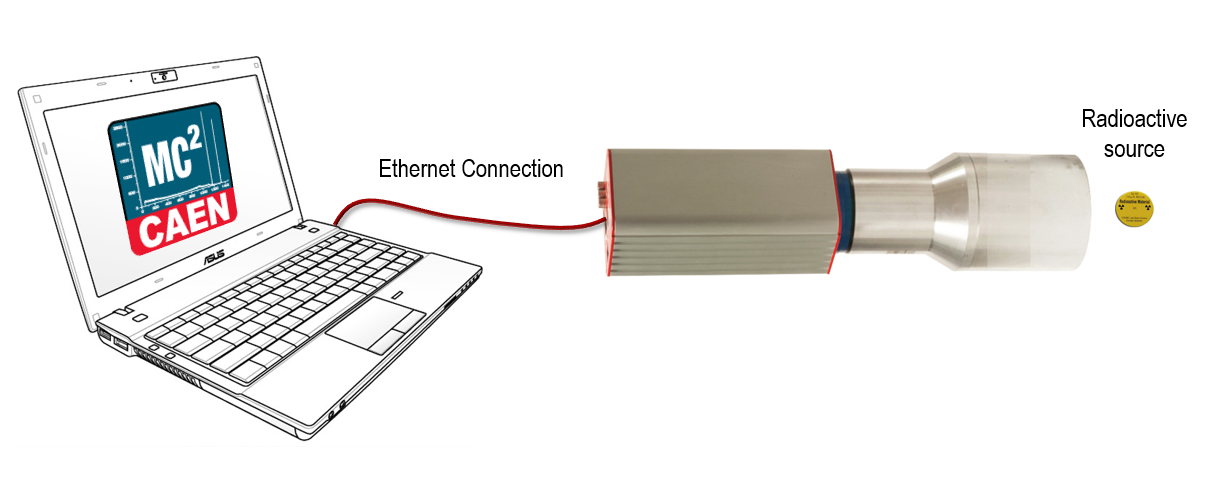
The experiment can be performed both by taking off the instrumentation from the backpack and using the backpack with the open zipper. To power ON γ-stream, press the ON/OFF button. Take care that the γ-stream internal battery is charged, otherwise use the external power system. Connect the Ethernet cable from γ-stream to the PC and configure the Ethernet network of your PC. Connect γ-stream to the MC2Analyzer software through Ethernet connection. Run the software, power ON the detector, set the acquisition time and acquire the background spectrum. Place the radioactive source close to the scintillator/under the central part of the backpack and acquire the γ-source spectrum.
Results
The student may get acquainted with the presence of radioactivity with a simple preliminary measurement, namely comparing the spectra acquired with/without the source. Presuming the source, essentially in contact to the crystal, to be point like with respect to the crystal surface, and assuming its activity is known, the student may estimate for every threshold value the detection efficiency and the signal over noise ratio, building up an efficiency-purity plot. Exemplary results obtained with a 137Cs source are shown. Moving away the source from the crystal, the law governing the variation of the flux can also be investigated.
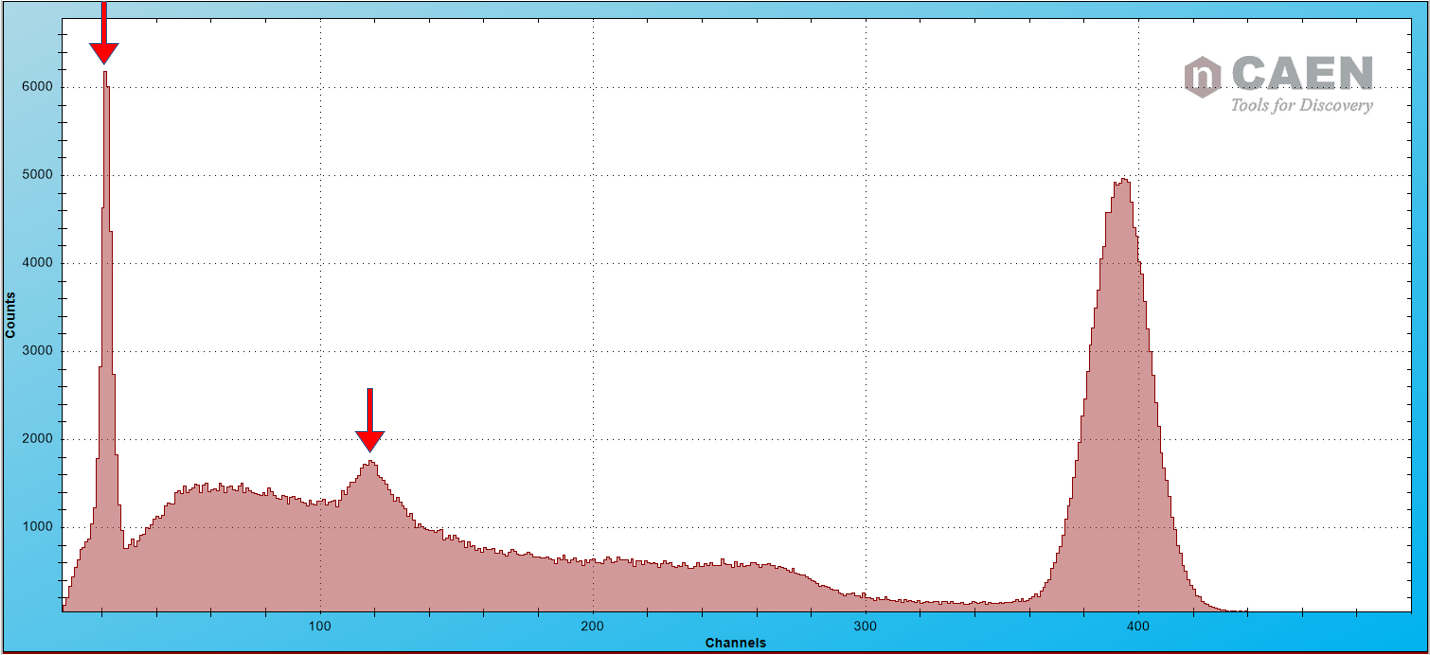
Comparison of background spectrum (blue profile) and 137Cs source spectrum (red) acquired by MC2Analyzer software.