| Difficult | Execution Time | Data Analysis | Radioactive Sources |
|---|---|---|---|
 |
 |
Yes | No |
Purpose of the experiment
This experiment introduces a pulse shape discrimination (PSD) technique based on the ratio between two integration areas of the same pulse. Students learn how different pulse shapes can be distinguished by comparing the charge collected in two different time intervals of the signal.
Fundamentals
In some detectors, different types of events produce pulses with similar amplitudes but different temporal shapes, especially in the decay portion of the signal. Pulse shape discrimination techniques can be used to distinguish these events by analysing how the signal evolves over time. A common PSD method consists of integrating the signal over two different time windows: a short gate and a long gate. The ratio between the charge collected in these two windows depends on the pulse shape and can be used to separate different types of events. In digital systems, this is implemented by computing two integrals of the waveform samples and calculating the ratio between the partial charge and the total charge.
Requirements
Python environment.
Carrying out the experiment
A firmware design is implemented including: a trigger block to detect incoming pulses, a short gate integrator, a long gate integrator, and a processing block that calculates the ratio between the two integrated charges. After compiling the design and programming the DT1260 board, the system can be tested using the DT4800 connected to the DT1260 analog input. For each detected pulse, the FPGA computes the charge collected in the short and long integration windows and then calculates their ratio. The results can be read and plotted using the control software.
Results
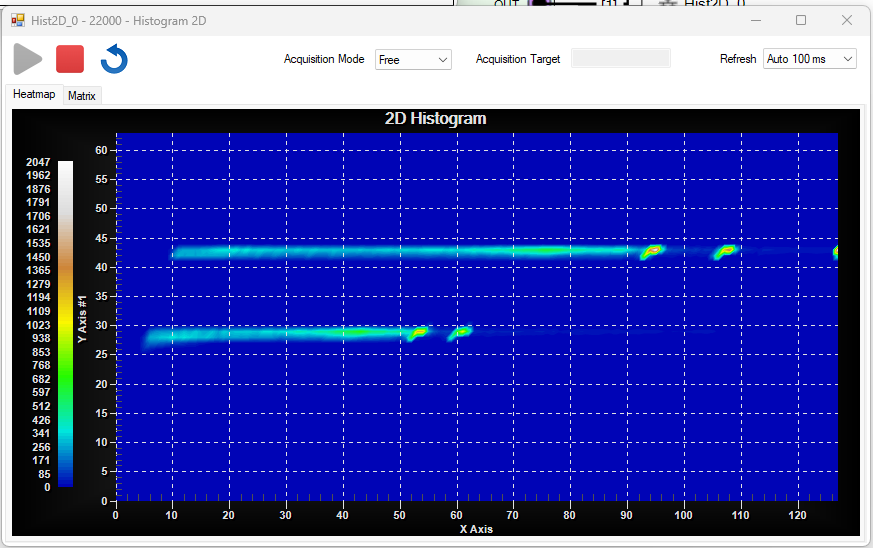
The system calculates the ratio between the short-gate charge and the long-gate charge for each detected pulse. By plotting these values, students can observe how pulses with different shapes produce different ratio values and form separate clusters. This experiment demonstrates how pulse shape discrimination based on charge integration can be used to distinguish between different types of detector signals in digital readout systems.