| Difficult | Execution Time | Data Analysis | Radioactive Sources |
|---|---|---|---|
  |
|
Yes | No |


Purpose of the experiment
The aim of this experiment is to demonstrate how the amplitude of detector pulses can be measured using a peak detection algorithm implemented in FPGA firmware.
Fundamentals
In many radiation and particle detection systems, the pulse amplitude is proportional to the energy deposited in the detector. Measuring the maximum value of the signal therefore provides important information about the detected event. A common technique to determine this value is peak detection, where the system continuously monitors the incoming waveform and records the highest sample value reached during the pulse. Once the pulse ends, this maximum value is stored as the amplitude measurement for that event. In digital readout systems, the signal is sampled by an Analog-to-Digital Converter (ADC) and processed by FPGA logic. The peak detection algorithm compares consecutive samples and keeps track of the highest value observed during the pulse window. This approach allows the system to measure pulse amplitudes in real time and store them for further analysis or histogram generation.
Requirements
Python environment.
Carrying out the experiment
Activate your Sci-Compiler license and set up the software installation. Plug the USB Dongle in your PC and launch Sci-Compiler. Create a project for your DT1260 unit: press New Project. A firmware design is implemented including:
- a trigger block used to detect incoming pulses,
- a peak detection module that tracks the maximum sample value during the pulse,
- registers used to store and access the detected peak value
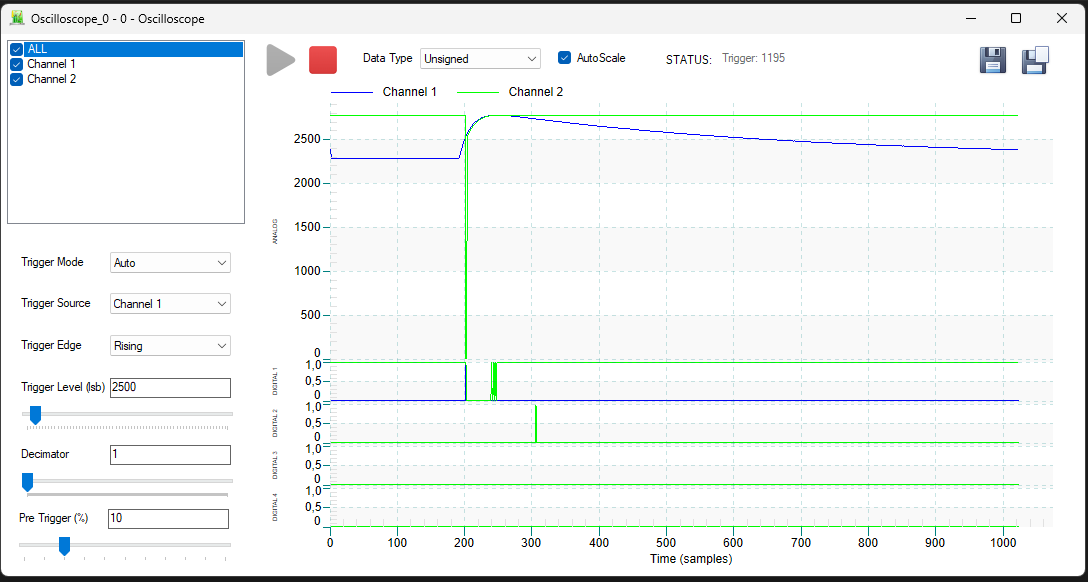
A signal generator is used to produce pulses with controlled amplitude. The FPGA processes the incoming waveform and records the peak value for each detected event. The results can then be read by the software application.
Results
The system detects and stores the maximum amplitude of each input pulse. Students learn how the peak value of a signal can be identified and recorded for each event, enabling digital amplitude measurements. By varying the input signal amplitude, the corresponding changes in the detected peak values can be observed.