| Difficult | Execution Time | Data Analysis | Radioactive Sources |
|---|---|---|---|
  |
  |
Yes | No |
Purpose of the experiment
The aim of this experiment is to demonstrate how event counting can be performed within a fixed time interval (dwell time) using FPGA logic. Students learn how to implement a timing-controlled acquisition that counts the number of detected events during a defined measurement period.
Fundamentals
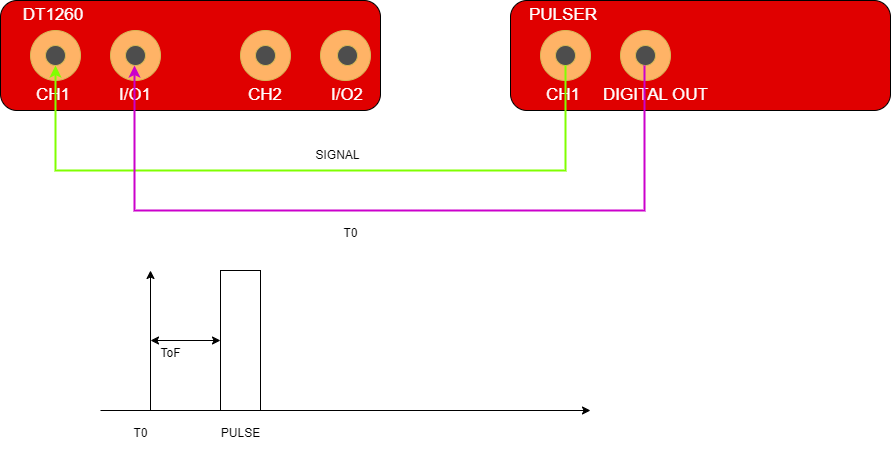
In many detector systems, timing information plays a crucial role in identifying events and reconstructing physical processes. Time-of-Flight (ToF) measurements determine the time difference between two signals, often corresponding to the arrival of a particle at two different detectors. This information can be used to estimate particle velocity or interaction position. Time-over-Threshold (ToT) measures how long a signal remains above a predefined threshold. Since the duration of this interval is related to the pulse amplitude, ToT can provide a simple estimate of signal strength. In digital readout systems, these quantities can be measured by detecting the leading and trailing edges of threshold crossings and counting clock cycles between them.
Requirements
Python environment.
Carrying out the experiment
Activate your Sci-Compiler license and set up the software installation. Plug the USB Dongle in your PC and launch Sci-Compiler. Create a project for your DT1260 unit: press New Project.
A firmware design is implemented including:
- a threshold discriminator to detect signal crossings,
- logic to identify the leading and trailing edges of pulses,
- counters or timers used to measure time intervals.
Input signals are provided to the board using a pulse generator. The FPGA measures the time difference between signals for ToF and the pulse duration above threshold for ToT. The measured values are then made available to the control software.
Results
The system successfully measures both the time difference between signals (ToF) and the duration of pulses above the threshold (ToT). By changing the timing or width of the input pulses, students can observe how the measured values vary. This experiment demonstrates how FPGA-based timing measurements can be used to extract temporal information from detector signals in digital readout systems.