| Difficult | Execution Time | Data Analysis | Radioactive Sources |
|---|---|---|---|
  |
  |
Yes | No |
Purpose of the experiment
The aim of this experiment is to demonstrate how event-by-event data can be recorded using a list data buffer implemented in FPGA firmware. Students learn how to store and read structured event data including timestamps and Time-over-Threshold (ToT) values for each detected signal.
Fundamentals
In many detector readout systems, measurements are not only accumulated into histograms but also recorded event by event. This approach, often called list mode acquisition, stores the relevant parameters of each detected event in a sequential data structure.
Typical event parameters include the timestamp, which identifies when the event occurred, and quantities such as Time-over-Threshold (ToT), which provide information about the signal duration above the discrimination
threshold.
These values are collected into a list data buffer inside the FPGA. Each entry in the buffer corresponds to a single detected event and contains the associated measurement parameters. The buffer can then be read by the control software for further analysis or visualization.
Requirements
Python environment.
Carrying out the experiment
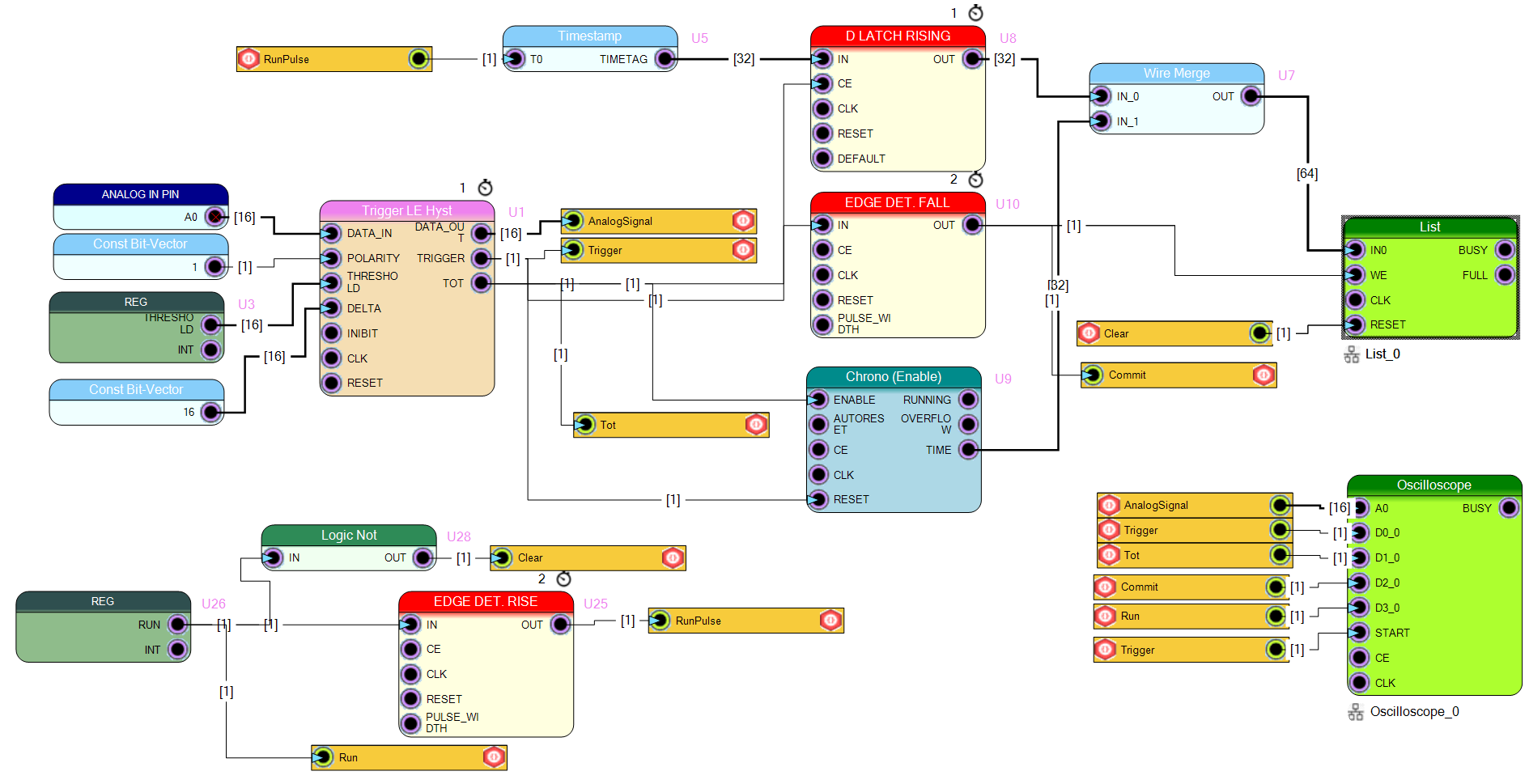
A firmware design is implemented including:
- a threshold discriminator to detect signal events
- logic to measure the Time-over-Threshold (ToT)
- a timestamp counter driven by the FPGA clock
- a list data buffer used to store event data sequentially
During operation, each detected event generates a record containing the timestamp and ToT value. These records are stored in the list buffer and periodically read by a Python program for inspection and analysis.
Results
The system produces a sequence of event records containing timestamps and ToT measurements. By reading the list data buffer, students can observe how each event is stored individually with its associated timing information. This experiment demonstrates how list mode acquisition allows detailed analysis of detector signals and provides a flexible alternative to histogram-based measurements in digital data acquisition systems.