| Difficult | Execution Time | Data Analysis | Radioactive Sources |
|---|---|---|---|
  |
 |
Yes | No |
Purpose of the experiment
This experiment introduces digital pulse processing techniques used to perform energy measurements with detector signals. Students explore how a trapezoidal filter and a Multi-Channel Analyzer (MCA) implemented in FPGA firmware can process incoming pulses and build an energy spectrum.
Fundamentals
In many radiation detection systems, the energy deposited in a detector is estimated from the amplitude of the processed signal. Digital pulse processing techniques are commonly used to improve measurement accuracy and reduce noise. A widely used method is trapezoidal filtering, which shapes the incoming pulse into a trapezoidal waveform. This digital filtering technique enhances the signal-to-noise ratio and produces a stable flat-top region from which the signal amplitude can be measured reliably. Once the pulse amplitude is determined, the measurement can be accumulated into a Multi-Channel Analyzer (MCA) histogram. Each detected event increments the bin corresponding to the measured amplitude, gradually forming an energy spectrum.
Requirements
Python environment.
Carrying out the experiment
Activate your Sci-Compiler license and set up the software installation. Plug the USB Dongle in your PC and launch Sci-Compiler. Create a project for your DT1260 unit: press New Project. A firmware design is implemented including:
- a trapezoidal filter used to shape the incoming signal,
- a measurement stage to determine the pulse amplitude from the filtered waveform,
- an MCA module that accumulates the measured values into a histogram.
During operation, incoming pulses are processed by the trapezoidal filter, and their amplitudes are assigned to the corresponding MCA channels. The resulting spectrum can then be read and visualized through the control software.
Results
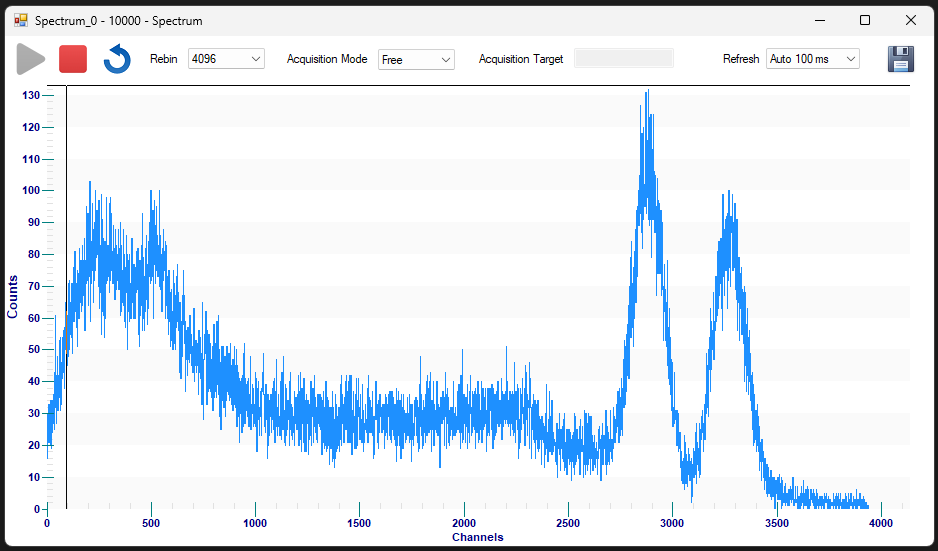
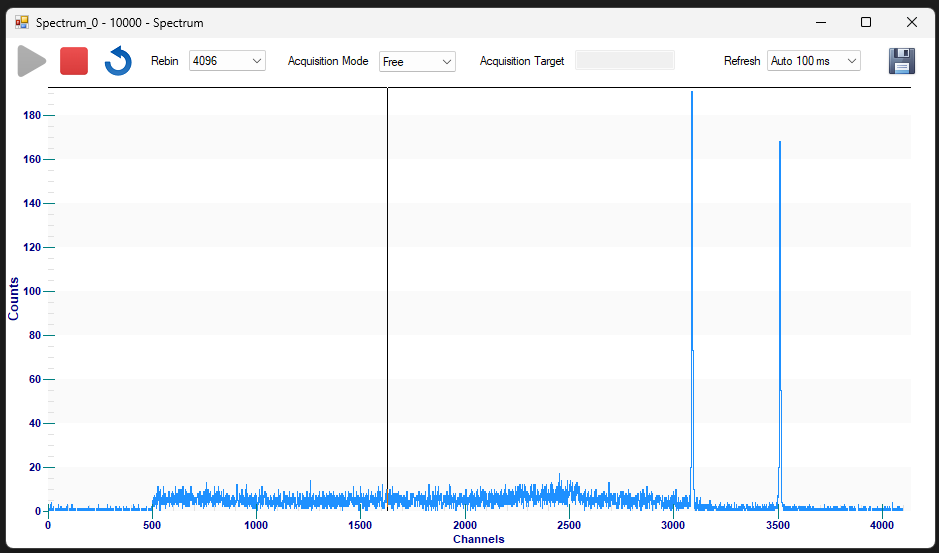
The system generates an energy spectrum by accumulating the processed pulse amplitudes into the MCA histogram. Students can observe how repeated measurements produce a distribution of events across the spectrum. This experiment shows how digital filtering and histogram accumulation enable spectroscopic measurements in FPGA-based detector readout systems.